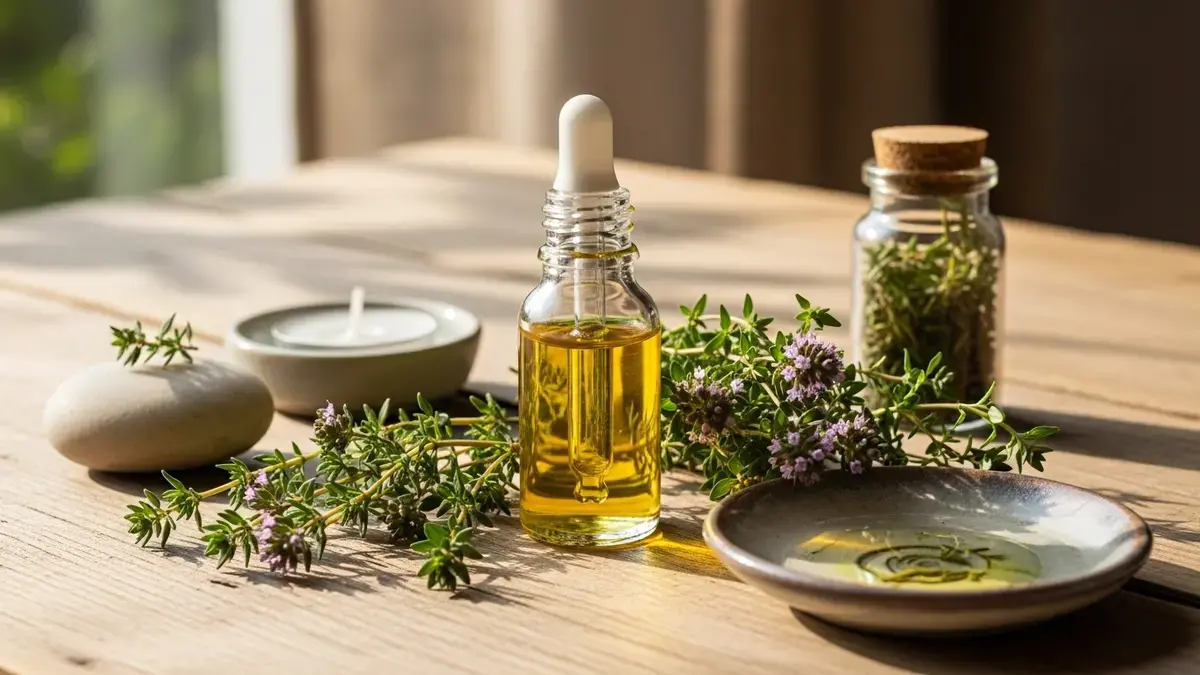
When we think of herbs that evoke strength and courage, thyme certainly comes to mind. Used by ancient Greeks and Romans for ritual baths and purifying incense, Thyme essential oil carries this legacy of power and protection.
Extracted from the Thymus vulgaris plant, a small shrub in the mint family (Lamiaceae), this oil is a powerhouse in aromatherapy. It's especially known for its impressive ability to support the immune and respiratory systems.
However, thyme is not a "simple" oil. Its chemical complexity demands that we be very specific. Different types of thyme offer different benefits and, more importantly, different safety profiles. Let's dive into the world of this essential oil and learn to use it with respect and efficacy.
Properties and Composition: The Secret is in the Chemotype
Thyme essential oil is typically steam distilled from the leaves and flowers of the plant. Its chemical composition can vary dramatically depending on where the plant grew, the altitude, and even the time of harvest. This gives rise to what we call chemotypes (ct.).
Understanding the chemotype is essential for using thyme safely. You should always look for this information (e.g., ct. Thymol) on your oil's label.
The Main Chemotypes of Thyme
- Thyme ct. Thymol: This is the most common and "aggressive" chemotype. Rich in phenols (mainly thymol and carvacrol), it is known for its potent purifying, cleansing, and protective properties. It's a "hot" oil, tonic, and stimulating, but it demands extreme care in topical applications.
- Thyme ct. Linalool: This is the "gentler" chemotype. Rich in alcohols (linalool), it maintains excellent cleansing properties but is much milder on the skin and respiratory system. It's a better choice for topical use or for children (with caution).
- Other Chemotypes: Others exist, like ct. Geraniol (more floral, good for skin) and ct. Thujanol (rare, known for its supportive properties and gentler nature), but Thymol and Linalool are the most common.
Due to this composition, the general properties of thyme oil include being a powerful immune-supportive, expectorant, tonic (mental and physical), and purifying agent.
Benefits and Applications of Thyme Essential Oil
Thyme essential oil is a true ally, especially during the colder months when seasonal challenges and fatigue seem to take hold.
Immune and Respiratory Support
This is, without a doubt, its greatest strength. Thyme is revered for its ability to cleanse and protect.
- Immune System Support: Used in a diffuser, thyme (especially ct. Thymol) helps purify the air in your environment, making it excellent support during times of seasonal sniffles.
- Soothes Stuffiness: As an expectorant, it helps promote a feeling of clear airways. Steam inhalation with thyme (preferably ct. Linalool to be gentler) can be very comforting.
- Purifying Action: Its cleansing properties make it great for helping to support a clear respiratory system.
Mental Stimulation and Focus
The herbaceous, penetrating aroma of thyme is a natural wake-up call for the mind.
- Combats Mental Fatigue: Thyme (ct. Thymol) is a powerful tonic, helping to uplift and energize when you're feeling sluggish or mentally tired.
- Clarity and Concentration: It's a great oil to diffuse during work or study, as it helps clear "mental fog" and supports focus.
- Courage and Resilience: Drawing on its ancient history, thyme is used in emotional aromatherapy to lend strength in moments of hesitation or fear.
Muscular and Body Comfort
Thyme essential oil (ct. Thymol) has a warming effect, making it useful for topical applications (always highly diluted) for physical comfort.
- Soothes Tired Muscles: Diluted in a carrier oil, it can be used in massage to warm and relax sore muscles after exercise.
- Supports Circulation: Its tonic and warming effect can help support local circulation when massaged into the skin.
Safe and Effective Ways to Use
Given its power, the method of use is crucial. Less is, definitively, more with thyme.
Aromatic Diffusion (The Purest Air)
This is one of the safest and most effective ways to use thyme. Add 3 to 5 drops to your ultrasonic diffuser.
- For intense purification: Use ct. Thymol for short periods (30 minutes at a time).
- For gentle respiratory support: Use ct. Linalool, which has a more pleasant aroma and is less irritating to the airways.
Topical Application (Dilution is Mandatory)
This is where knowing the chemotype is vital. NEVER, EVER, apply undiluted thyme essential oil to the skin.
- For Thyme ct. Thymol: Dilution must be a maximum of 1%. This means 1 drop of essential oil for every 5ml (one teaspoon) of carrier oil (like jojoba or sweet almond).
- For Thyme ct. Linalool: This is safer and can be used in a 2% to 3% dilution (2 to 3 drops per 5ml of carrier) for adults.
Use in massage on the chest (for a comforting feeling), abdomen, or on tired muscles.
Steam Inhalation (Breathe Easy)
For stuffiness, add 1 single drop of thyme (preferably ct. Linalool) to a bowl of hot (not boiling) water. Cover your head with a towel and inhale the steam for 5 minutes, keeping your eyes closed. It is intense, so start slowly.
Safety Warnings and Precautions (MANDATORY READING)
Thyme essential oil is incredibly potent, and its power demands respect. This section is vital to ensure safe use and to enjoy its benefits without risk. Content must comply with health authority guidelines.
❌ Critical Warnings (Especially Chemotype Thymol)
- Skin Irritation / Dermocaustic: Phenol-rich chemotypes (Thymol, Carvacrol) are highly irritating to the skin and mucous membranes. Using them undiluted can cause skin irritation or severe sensitization. The 1% maximum dilution for ct. Thymol is a strict safety rule. Ct. Linalool is considerably gentler but still requires dilution.
- Contraindications:
- Pregnancy and Nursing: Contraindicated. Thyme can be overly stimulating.
- Children: Avoid use on children under 6 years old. For older children (6-10), use only the Linalool chemotype, in a very low dilution (0.5%), and diffusion is preferred.
- High Blood Pressure (Hypertension): Individuals with hypertension should avoid the stimulating chemotypes (Thymol, Carvacrol), as they may be too strong. Ct. Linalool is generally considered a safer choice.
-
Sensitive Skin: Those with sensitive skin should avoid ct. Thymol entirely and use ct. Linalool with extreme caution.
-
Drug Interactions: Thyme, especially ct. Thymol, may inhibit blood clotting. People taking anticoagulant (blood-thinning) medications (e.g., Warfarin, Aspirin) should avoid its use.
⚠️ Additional Precautions & General Warnings
- Pet Safety Warning (Especially Cats): EXTREME CAUTION. Thyme essential oil, being rich in phenols (Thymol), is highly toxic to cats. Cats lack the necessary liver enzymes (glucuronidation) to metabolize these compounds, leading to liver failure and potentially death. Do not use in diffusers, sprays, or topically in homes with cats. Dogs can also be sensitive.
- Patch Test: Before using any new oil topically, even diluted, perform a patch test. Apply a small amount to your inner elbow and wait 24 hours for any reaction.
- Internal Use (Ingestion): Do not ingest thyme essential oil. Internal use should only be undertaken under the express guidance of a qualified healthcare professional (MD, DO) with training in clinical aromatherapy.
- Eyes and Mucous Membranes: Keep oil away from eyes, inner ears, and other sensitive areas.
FDA Disclaimer
The information provided on this Aromatherapy Blog is for educational purposes only. It is not intended to diagnose, treat, cure, or prevent any disease. These statements have not been evaluated by the Food and Drug Administration (FDA). Always consult your physician or a qualified healthcare professional before starting any new aromatherapy or wellness routine, especially if you have a pre-existing medical condition or are taking medication.
Blends and Synergies: Enhancing Thyme
Thyme's strong aroma often benefits from blending, which can soften its intensity and complement its effects.
Complementary Essential Oils
- For Breathing: Blends wonderfully with Eucalyptus (Radiata or Globulus), Peppermint, and Rosemary (ct. Cineole).
- For Immunity Support: Create a supportive blend with Lemon, Clove Bud, and Tea Tree (Melaleuca).
- For Mental Focus: Combine with Lemon or Bergamot for an uplifting, citrusy aroma.
- For Relaxation (using ct. Linalool): Mix with Lavender or Roman Chamomile for a calming and supportive nighttime blend.
Ideal Carrier Oils
For topical use, thyme essential oil needs a base. Jojoba Oil, Sweet Almond Oil, or Grapeseed Oil are all excellent, light choices that absorb well.
Final Thoughts: The Power of the Right Choice
Thyme essential oil is, without question, one of the giants of aromatherapy. Its ability to protect, support, and energize is almost unparalleled.
However, its use teaches us one of the most important lessons in this field: the chemotype matters. Knowing whether you have a Thyme ct. Thymol or a Thyme ct. Linalool completely changes the approach to use, the efficacy, and, most importantly, the safety.
By respecting its potency, understanding its chemistry, and following safety guidelines (especially dilution!), you can incorporate thyme into your routine as a powerful guardian of your physical and mental wellness.