Ah, patchouli essential oil. Few aromas in the aromatherapy world are so polarizing: you either love it or you hate it. Often associated with the hippie movement of the 60s and 70s, this oil is much more than a "trip to the past." In fact, it's one of the most valuable and versatile oils that exist, especially for the skin and mind.
Its scent is unmistakable: deep, earthy, musky, slightly sweet, and woody. But the real secret of patchouli (Pogostemon cablin) is that, much like a fine wine, it improves with age. A newly distilled patchouli oil might be more "green," but an oil aged for years becomes deeper, richer, and more complex.
If you want to go beyond the stereotypes and discover the grounding and rejuvenating power of this incredible oil, this guide is for you. We'll explore its chemistry, its real benefits, and, most importantly, how to use it with total safety.
Properties and Composition
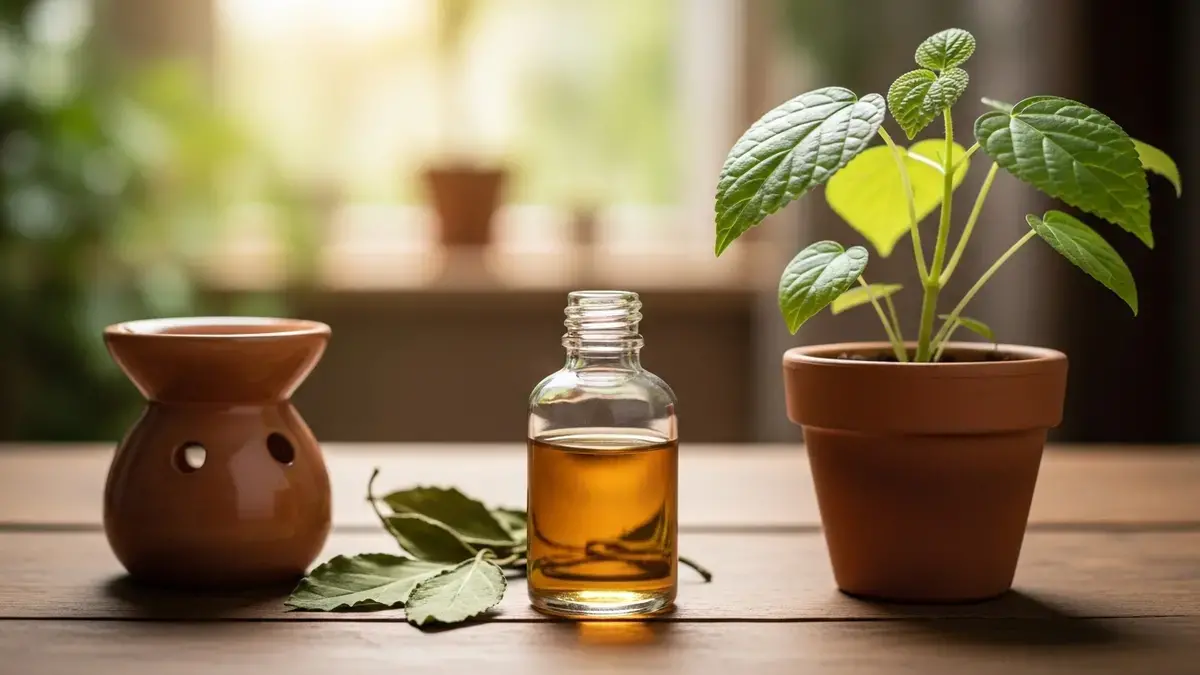
Patchouli essential oil doesn't come from wood or resin, as many think, but from the leaves of a green, leafy shrub native to Asia. The extraction process is what makes it unique: the leaves are harvested, dried, and often go through a light fermentation process before steam distillation.
This curing process is what helps develop the richness of its aroma and its chemical composition. The oil is thick (viscous) and usually has a color that ranges from amber to dark brown, especially if it's aged.
Chemically, it is dominated by sesquiterpenes (like alpha-bulnesene and alpha-guaiene), but its star component is a sesquiterpene alcohol called Patchoulol (or patchouli alcohol). It's this component that gives the oil most of its characteristic aroma and its incredible calming and skin-supporting properties.
Benefits and Applications
Patchouli is the definition of a base note. Its effects are deep, long-lasting, and work on both the physical (skin) and mental (emotions) levels.
Mental and Emotional Support
If you feel "spaced out," "airy," or like your head is in the clouds, patchouli is your oil. It is the great grounding agent of aromatherapy.
- Calming and Centering: It's one of the best oils for easing anxious feelings, racing thoughts, and stress. It doesn't sedate you; it "pulls you into the present," helping to connect the mind to the body.
- Emotional Balance: It is very useful in moments of indecision or instability, bringing a sense of solid ground and calm.
- Sensual Atmosphere: By reducing stress and connecting us to our physical body, the musky, exotic aroma of patchouli is renowned for helping to create a sensual and relaxed atmosphere.
Physical Support and Skincare
This is where patchouli truly excels. It is, without a doubt, one of the most important oils for skincare.
- Skin Rejuvenation Support: It is known to support the skin's natural restorative process. It's fantastic for improving the appearance of scars, stretch marks, and blemishes.
- Mature Skin Ally: For its supportive properties, it's a top-tier ingredient in cosmetics for mature skin, helping to tone and soften the appearance of fine lines.
- Soothing Action: It's wonderful for calming irritated-looking skin and is often used to support skin comfort.
- Sebum Balancing: It's an adaptive oil: it helps moisturize dry, cracked skin, while its astringent properties help balance oily, blemish-prone skin.
- Scalp Health: It's a classic addition to shampoos and hair tonics, helping to combat a flaky, oily scalp.
How to Use Patchouli Oil
A single drop of patchouli essential oil is potent, and its scent lasts a long time. Always start with a little.
- Aromatic Diffusion: The best way to get its grounding benefits. Use 3 to 5 drops in your diffuser. It's perfect for meditation, yoga, or for creating a relaxing, sensual environment at night.
- Topical Application (Skincare): The most effective use for the skin. Dilution is always mandatory.
- Facial Serum (Mature or Blemish-Prone Skin): 0.5% to 1% dilution (1 to 2 drops of patchouli for every 10ml of carrier oil).
- Body Oil (Scars/Dry Skin): 1% to 2% dilution (3 to 6 drops for every 10ml of carrier oil).
- Direct Inhalation: For a "reality check" during a moment of overwhelm, place 1 drop on a tissue and inhale deeply. It grounds you immediately.
Safety Alerts and Precautions
ATTENTION: This section is vital for your safety and for AdSense compliance. Fortunately, patchouli is considered one of the safest and gentlest essential oils available.
❌ Risk of Skin Irritation (Dermocausticity)
Risk: Non-existent. Patchouli essential oil is not dermocaustic. On the contrary, it is known for being extremely gentle and soothing to the skin, and is generally non-irritating and non-sensitizing.
❌ Phototoxicity
Risk: Non-existent. Patchouli is not phototoxic. It is perfectly safe to use on the skin (diluted) and go in the sun.
❌ Neurotoxicity
Risk: Non-existent. It is not considered neurotoxic.
❌ Contraindications
It is a very safe oil without major contraindications. However, as a general precaution, use with moderation during pregnancy (especially the first 3 months) and consult your doctor.
❌ Drug Interactions (Anticoagulants)
RISK: Moderate (Theoretical). Patchouli oil may have a mild anti-platelet (blood-thinning) action. People taking anticoagulant medications (e.g., Warfarin) or who have bleeding disorders should consult a physician before regular topical use.
⚠️ Risk to Pets (Pet Owner Alert)
Keep essential oils out of reach of animals. Especially Cats: Cats lack the necessary liver enzyme (glucuronyltransferase) to metabolize the sesquiterpenes found in patchouli. Exposure can be toxic and lead to severe liver damage. Avoid topical use and diffusion in enclosed spaces with them.
⚠️ General Usage Precautions
- Patch Test: Even though it's a gentle oil, a patch test is always recommended. Apply a small, diluted amount to the inner elbow and wait 24 hours.
- Never Ingest: Ingestion of essential oils should only be done under the guidance of a qualified clinical aromatherapist.
- Keep Away From Eyes: Avoid contact with eyes and mucous membranes.
Medical Disclaimer: The information on this post is for educational purposes only and does not substitute for professional medical advice. Always consult a qualified healthcare professional. These statements have not been evaluated by the Food and Drug Administration (FDA). This product is not intended to diagnose, treat, cure, or prevent any disease.
Combinations and Synergies
In perfumery, patchouli is a world-famous "fixative." This means it anchors lighter aromas (like citruses) and makes the blend last much longer on the skin.
- Floral Synergies (Sensual): Blends divinely with Rose, Jasmine, Ylang Ylang, and Geranium, balancing their sweetness.
- Grounding Synergies: Combine with other base notes like Vetiver, Sandalwood, Cedarwood, and Frankincense.
- Citrus Synergies (Uplifting): Use one drop of patchouli to "hold" volatile oils like Bergamot, Sweet Orange, or Lemongrass.
- Ideal Carrier Oils: Jojoba Oil (for oily/blemish-prone skin), Rosehip Oil (for mature skin/scars), or Sweet Almond Oil (for body moisturizing).
Final Thoughts
Patchouli essential oil is much more than its "hippie" reputation. It is a profound wellness tool, one of the best friends for mature and irritated-looking skin, and an unparalleled balm for a restless, racing mind.
Give this incredible oil a chance. Look for one that is aged, if possible, and discover the power of having your feet firmly on the ground. Used safely and respectfully, patchouli can become one of the pillars of your aromatherapy practice.